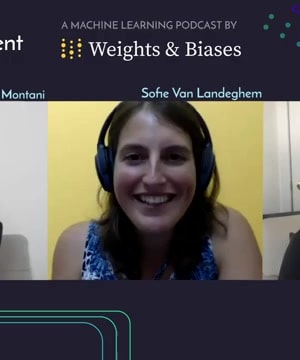
Ines & Sofie — Building Industrial-Strength NLP Pipelines

Topics covered
Popular Clips




Episode Highlights
Configuration System
The configuration system in spaCy V3 is a game-changer for NLP workflows, offering a robust and flexible way to manage complex setups. highlights the importance of this system, noting how it allows users to define every component in an NLP pipeline, making it easier to tune parameters and ensure reproducibility 1. adds that the system's design facilitates end-to-end workflows through spaCy projects, enabling users to manage dependencies and integrate with other libraries seamlessly 2. This approach not only simplifies debugging but also enhances user experience by providing immediate feedback on configuration errors 3.
Bugs will happen and things can go wrong. Machine learning is just hard and it's complex.
---
The configuration system thus empowers developers to create more reliable and efficient NLP applications.
Efficiency Choices
spaCy's design prioritizes efficiency, setting it apart from research-focused NLP libraries. explains that spaCy provides reasonable defaults and efficient transformer integrations, allowing users to process large volumes of text at scale 4. The library's architecture is optimized for production use, focusing on practical applications rather than benchmarking multiple models 5. also discusses the role of Python in spaCy's development, emphasizing its versatility and the use of Cython for performance enhancements 6.
Python was there at the right time, in the right place. It was fast enough, it had support for C extensions, but it was also a general purpose language.
---
These choices make spaCy a powerful tool for industrial-strength NLP applications.
Multilingual Support
Supporting multiple languages in NLP models presents unique challenges, which spaCy addresses through community-driven solutions and specialized plugins. notes that spaCy's tokenization is linguistically motivated, requiring careful consideration of each language's characteristics 7. highlights the importance of domain-specific models, such as those for biomedical or legal texts, which are supported by plugins in the spaCy universe 7. This adaptability allows users to tailor models to specific needs, reflecting a shift in how NLP is applied across different industries 8.
You really want to train your model on that specific domain.
---
Such flexibility ensures that spaCy remains relevant and effective in diverse linguistic and domain contexts.
Related Episodes


Piero Molino — The Secret Behind Building Successful Open Source Projects
Answers 383 questions
Hamel Husain — Building Machine Learning Tools
Answers 383 questions
Adrien Treuille — Building Blazingly Fast Tools That People Love
Answers 383 questions
Richard Socher — The Challenges of Making ML Work in the Real World
Answers 383 questions
Accelerating drug discovery with AI: Insights from Isomorphic Labs
Answers 383 questions
Transforming Search with Perplexity AI’s CTO Denis Yarats
Answers 383 questions
Nicolas Koumchatzky — Machine Learning in Production for Self-Driving Cars
Answers 383 questions
Angela & Danielle — Designing ML Models for Millions of Consumer Robots
Answers 383 questions
Elevating ML Infrastructure with Modal Labs CEO Erik Bernhardsson
Answers 383 questions
Sean Gourley — NLP, National Defense, and Establishing Ground Truth
Answers 383 questions
Jerome Pesenti — Large Language Models, PyTorch, and Meta
Answers 383 questions
Emily M. Bender — Language Models and Linguistics
Answers 383 questions
Operationalizing Machine Learning: Interview with Shreya Shankar
Answers 383 questions
Spence Green — Enterprise-scale Machine Translation
Answers 383 questions