Elevating ML Infrastructure with Modal Labs CEO Erik Bernhardsson

Topics covered
Popular Clips
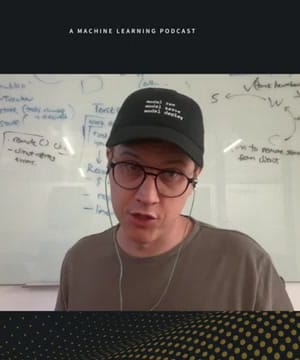


Episode Highlights
Scaling Complexity
Erik Bernhardsson, CEO of Modal Labs, highlights the complexities of scaling machine learning workloads in production environments. He explains that handling thousands of GPUs and managing 10,000 requests per second requires a robust infrastructure, which Modal Labs provides to its clients, allowing them to focus on building custom pipelines without the hassle of infrastructure management 1. Erik also discusses the importance of cloud infrastructure, noting that Modal Labs is fully cloud-hosted, which differentiates it from other solutions like Ray and Databricks 2. This approach allows for a serverless model where clients are only charged for the time their code runs, optimizing both cost and efficiency 3.
The big challenge is just scale and stability and performance. When you're running thousands and thousands of GPU's at scale and handling, I don't know, 10,000 requests a second.
---
This focus on scalability and cloud infrastructure positions Modal Labs as a leader in the ML infrastructure space.
Workflow Innovations
Modal Labs is pioneering custom workflow innovations to enhance AI inference processes. Erik Bernhardsson shares his vision of creating a comprehensive stack that supports the entire AI lifecycle, from data preprocessing to training and inference 4. He acknowledges the challenges in dynamic function deployment, where users often resort to hacky solutions due to current limitations in the platform 5. Despite these challenges, Erik emphasizes the importance of a seamless onboarding experience, which he believes is as crucial as the core product itself 6.
I always think the onboarding experience is as core of a product experience as like the actual core model, SDK itself.
---
This commitment to improving user experience and functionality underscores Modal Labs' dedication to innovation.
Future Vision
Looking ahead, Erik Bernhardsson envisions a future where Modal Labs expands its reach beyond traditional Python-based machine learning engineers. He notes the growing interest from software engineers using languages like JavaScript, who are exploring AI capabilities through tools like OpenAI 7. Erik is keen on diversifying Modal Labs' offerings to cater to this emerging audience while maintaining its core focus on Python developers 8. He also asserts that despite advancements in language models, ML engineers will remain indispensable in the field 9.
I don't think LMs are going to replace ML engineers.
---
This strategic vision highlights Modal Labs' commitment to staying at the forefront of ML infrastructure innovation.
Related Episodes


Chris Albon — ML Models and Infrastructure at Wikimedia
Answers 383 questions
From Startup to $1.2B with Lambda Labs' Stephen Balaban
Answers 383 questions
Aaron Colak — ML and NLP in Experience Management
Answers 383 questions
Jensen Huang — NVIDIA's CEO on the Next Generation of AI and MLOps
Answers 383 questions
Johannes Otterbach — Unlocking ML for Traditional Companies
Answers 383 questions
Jeremy Howard of fast.ai— The Simple but Profound Insight Behind Diffusion
Answers 383 questions
Richard Socher — The Challenges of Making ML Work in the Real World
Answers 383 questionsRedefining AI Hardware for Enterprise with SambaNova's Rodrigo Liang
Answers 383 questions
Piero Molino — The Secret Behind Building Successful Open Source Projects
Answers 383 questions
Operationalizing Machine Learning: Interview with Shreya Shankar
Answers 383 questions
Angela & Danielle — Designing ML Models for Millions of Consumer Robots
Answers 383 questions
Luis Ceze — Accelerating Machine Learning Systems
Answers 383 questions
Reinventing AI Agents with Imbue CEO Kanjun Qiu
Answers 383 questions