Daphne Koller — Digital Biology and the Next Epoch of Science

Topics covered
Popular Clips


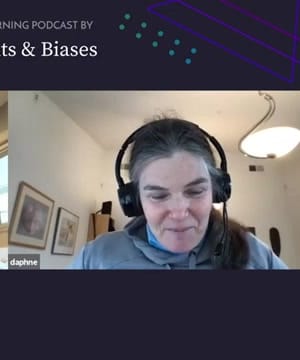


Episode Highlights
ML Evolution
The evolution of data and machine learning has significantly transformed various fields, including biology. highlights the progress from 2004 to 2018, where machine learning models have surpassed human capabilities in tasks like image recognition 1. She attributes this to better models, larger datasets, and advanced computing power. The availability of comprehensive datasets, such as the UK Biobank, has been transformative in understanding human biology and developing new methodologies 2. notes, "The combination of better software, better tooling, and better cloud computing has been as transformative as anything else."
Transfer Learning
Transfer learning is becoming increasingly relevant in machine learning, with applications extending across various domains. explains how models trained on web images can be transferred to microscopy images, showcasing the adaptability of these models 3. This adaptability is crucial for advancing fields like drug discovery, where data scarcity is a challenge. emphasizes the need for large datasets to enable machine learning to break through performance ceilings, as demonstrated by DeepMind's AlphaFold in protein folding 4. She states, "We need to be really thinking hard about how to generate enough data at scale for biological or chemical problems."
Protein Folding
Breakthroughs in protein folding illustrate the potential of machine learning in biology. discusses how DeepMind's AlphaFold achieved a significant milestone by not relying on preconceptions about physics and chemistry, but instead using vast amounts of data 5. This approach allowed AlphaFold to solve complex problems that traditional methods could not. points out that while protein folding is not the core issue in drug discovery, it exemplifies how machine learning can tackle challenging problems 4. "Machine learning came in and with the right type of model and the right type of data, was really able to crack that nut open," she remarks.
Related Episodes


Sean and Greg — Biology and ML for Drug Discovery
Answers 383 questions
Accelerating drug discovery with AI: Insights from Isomorphic Labs
Answers 383 questions
Jeff Hammerbacher — From data science to biomedicine
Answers 383 questions
D. Sculley — Technical Debt, Trade-offs, and Kaggle
Answers 383 questions

Roger & DJ — The Rise of Big Data and CA's COVID-19 Response
Answers 383 questions
Matthew Davis — Bringing Genetic Insights to Everyone
Answers 383 questions
Daeil Kim — The Unreasonable Effectiveness of Synthetic Data
Answers 383 questions
Johannes Otterbach — Unlocking ML for Traditional Companies
Answers 383 questions
Zack Chase Lipton — The Medical Machine Learning Landscape
Answers 383 questions
Richard Socher — The Challenges of Making ML Work in the Real World
Answers 383 questions
Boris Dayma — The Story Behind DALL·E mini, the Viral Phenomenon
Answers 383 questions
Anthony Goldbloom — How to Win Kaggle Competitions
Answers 383 questions
Polly Fordyce — Microfluidic Platforms and Machine Learning
Answers 383 questions
Angela & Danielle — Designing ML Models for Millions of Consumer Robots
Answers 383 questions