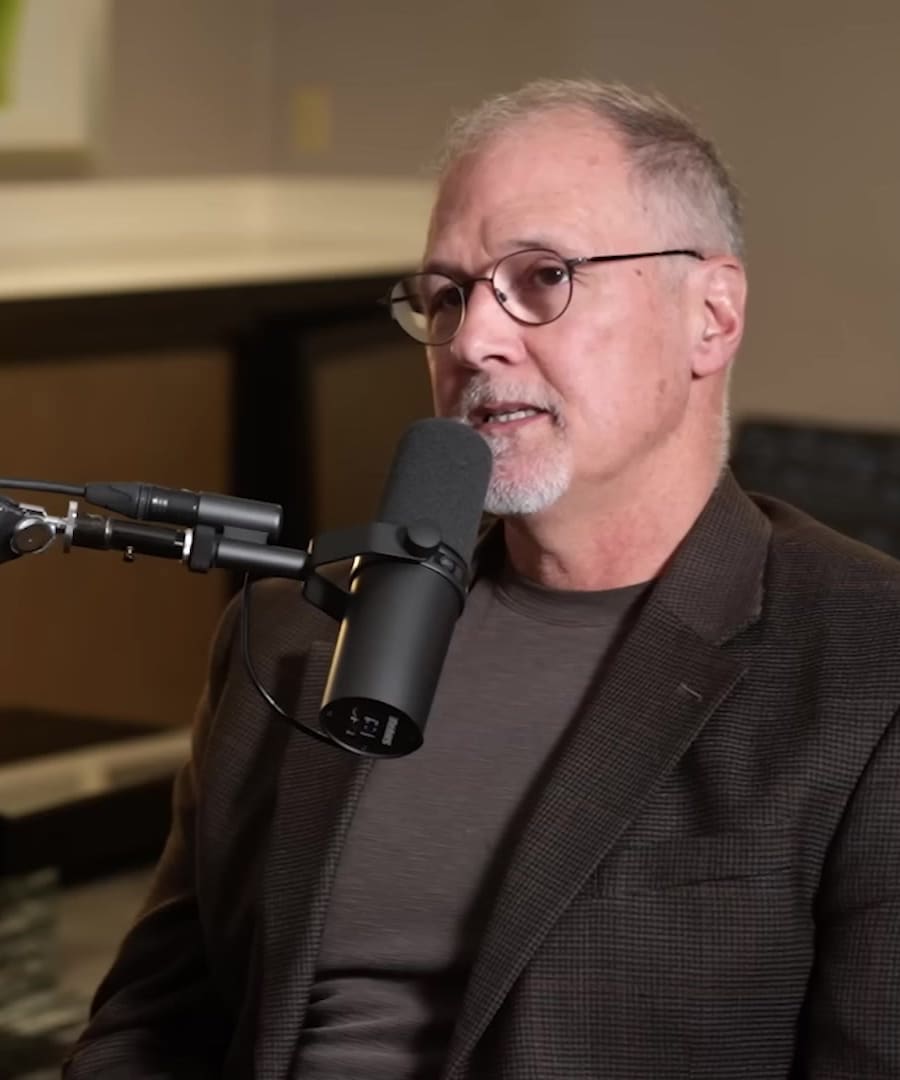
Robert Playter: Boston Dynamics CEO on Humanoid and Legged Robotics | Lex Fridman Podcast #374

Topics covered
Popular Clips








Questions from this episode
- Asked by 220 people
- Asked by 172 people
- Asked by 155 people
- Asked by 82 people
- Asked by 40 people
Episode Highlights
Spot's Development
The development of the Spot robot marked a significant evolution in Boston Dynamics' approach to robotics. explains that Spot was born out of a need to transition from large, gas-powered quadrupeds to smaller, electrically actuated robots, driven by the vision of creating a consumer-level product 1. This shift was influenced by Larry Page, who emphasized the importance of everyday usability in products. Playter notes that while cost was a secondary concern, the primary focus was on pushing the limits of what was possible with robotics 2. Spot's applications have since expanded, with Boston Dynamics working closely with customers to automate complex tasks, such as industrial monitoring and manipulation 3.
We love working with customers who have challenging problems like this, and this one in particular, because we felt like what they were doing, a, it was a safety feature.
---
The company aims to sell thousands of robots to achieve commercial success, focusing on broad applications that ensure reliability and utility.
BigDog's Legacy
The early days of Boston Dynamics were marked by the development of BigDog, a quadruped robot that laid the groundwork for future innovations. recounts the challenges faced with BigDog, such as navigating loose rock and sand, which required innovative solutions to maintain stability 4. This period was crucial in proving the viability of legged locomotion, leading to the creation of various other models like LS3 and Cheetah, each designed to explore different capabilities 5. The DARPA Robotics Challenge further pushed the boundaries, tasking humanoid robots with complex tasks to advance the field of robotics 6.
We built other quadrupeds like LS3, designed to carry heavy loads. We built Cheetah, which was designed to explore what are the limits to how fast you can run.
---
These efforts established foundational principles for legged robots, enabling Boston Dynamics to scale and diversify their robotic systems.
Industrial Applications
Boston Dynamics has focused on practical applications of legged robots, addressing both technological challenges and industry needs. highlights the importance of reliability testing, with robots autonomously performing tasks to ensure consistent performance in real-world settings 7. Automating dangerous tasks, such as operating high-powered breaker switches, showcases the potential of robots to enhance safety in hazardous environments 8. Despite the challenges in achieving profitability, Boston Dynamics has identified industrial monitoring as a promising area, leveraging robots for tasks like thermal imaging and vibration measurement to prevent costly shutdowns 3.
We have these robots programmed to do autonomous missions, get up off their charging dock, walk around the building, collect data at a few different places and go sit back down.
---
The company's strategy involves scaling production to meet demand and ensure the economic viability of their robotic solutions.
Related Episodes


Rodney Brooks: Robotics | Lex Fridman Podcast #217
Answers 383 questions
Kate Darling: Social Robotics | Lex Fridman Podcast #98
Answers 383 questions
Sertac Karaman: Robots That Fly and Robots That Drive | Lex Fridman Podcast #97
Answers 383 questions
Sergey Levine: Robotics and Machine Learning | Lex Fridman Podcast #108
Answers 383 questions
Colin Angle: iRobot CEO | Lex Fridman Podcast #39
Answers 383 questions
Peter Norvig: Artificial Intelligence: A Modern Approach | Lex Fridman Podcast #42
Answers 383 questions