Create a table to show difference between Microsoft and Google
Sources:
Below is a comparison between Microsoft and Google based on proffered insights by experts in various podcasts:
Feature Microsoft Google Approach to Innovation Focused on cloud and transforming their business model under CEO Satya Nadella, with attention to cloud-first and making their services ubiquitous across devices. Utilizes a more traditional tech infrastructure software approach 1. Initially disrupted markets with simple and scalable solutions, like Google Docs taking on Microsoft’s complex suite. Innovates by leveraging its dominance in search and the data it gathers to improve products 2. Business Model Generates significant revenue from cloud services and professional software, alongside hardware and gaming sectors 3. Started as a project, becoming a business by accident. Created a monopoly in search quickly due to self-reinforcing data loops. Struggles in areas outside its core competencies like enterprise services 4. Financial Performance Known for operational efficiency, generating higher profits relative to expenses. Aggressively returns value to shareholders through buybacks and dividends 5. Although it has high gross margins in search, it doesn't manage costs as efficiently as competitors. Google's scaling in enterprise sectors hasn’t matched that of Microsoft 5. Culture and Leadership Described as humble, driven by hard work, and led by an empathetic and motivational CEO, fostering a culture that continually innovates while retaining a strong leadership structure 3. Driven by engineering brilliance, emphasizing the creation of groundbreaking technology and maintaining a less traditional approach to corporate structure, which sometimes leads to strategic missteps 1. Market Strategy Transformed under CEO Satya Nadella to embrace a mobile and cloud-first strategy, shifting away from overreliance on Windows. Strong focus on enterprise and cloud infrastructure markets 1. Leverages strong search engine monopoly for ad revenue while struggling with hardware and enterprise software market penetration. Less effective in translating technological innovations into profitable enterprise solutions 4. These comparisons highlight the strategic, operational, and cultural differences between Microsoft and Google as discussed by the experts.
RELATED QUESTIONSHow open AI destroy Google gradually?
Sources:
OpenAI's gradual impact on Google is primarily discussed through the lens of open-source AI development, as highlighted by experts like Nathaniel Whittemore. Here are some key points regarding how OpenAI could challenge Google:
-
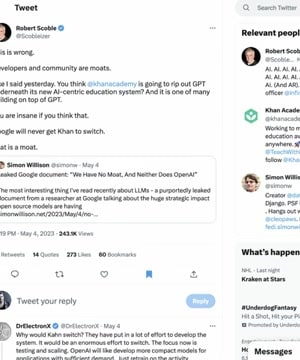
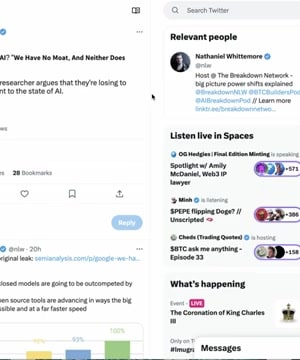
Open Source Model: Google is perceived as being outcompeted by open-source developments in AI. A leaked memo from a Google researcher highlighted their concern, stating that Google has "no moat" against open-source competitors, indicating that open-source AI initiatives could disrupt traditional AI business models favored by large corporations like Google. Nathaniel Whittemore discussed this in the context of OpenAI and other open initiatives gaining traction rapidly 1.
-
Developer Community and Adoption: OpenAI's strategy significantly involves building a robust developer community. The adoption and integration of OpenAI’s technologies, especially in prompt engineering, have been widely embraced by the developer community. This community-driven approach creates a kind of "moat" for OpenAI, which contrasts with Google’s approach, possibly limiting Google's influence in certain areas of AI development 2.
-
AI Development and Deployment: Open source AI, championed by platforms like OpenAI, poses a classical competitive threat to Google by democratizing access to AI technologies. This broad access allows independent developers and smaller entities to innovate at a pace and direction that might be incongruent with Google's structured, large-scale AI initiatives 3.
These discussions suggest a shift in the AI landscape where traditional moats like proprietary technology and scale might be less effective against a backdrop of rapid, community-driven innovation embraced by entities like OpenAI.
RELATED QUESTIONS-
Summarise and write in only 5 lines accurately and straightly
Sources:
OpenAI could potentially disrupt Google primarily through its innovations in AI search applications, which might challenge Google's core search business. Experts like David Friedberg and Chamath Palihapitiya discuss how a shift toward natural language processing and AI-driven search could fundamentally alter the traditional search box, leading to a new interface that heavily utilizes conversational AI. This could create significant competition for Google, potentially transforming the search landscape and reducing Google's dominance in this area 1.
RELATED QUESTIONSDiscuss future search interfaces and how they might change.
Sources:
The future search interfaces are expected to integrate more voice and conversational elements, accommodating longer, context-rich queries. As voice technology improves, search engines will need to adapt by combining traditional keyword-based searching with vector and model-based interpretations of queries to provide more relevant results 1. Moreover, emerging AI-driven platforms are exploring the concept of "research engines," which enhance the experience for users conducting in-depth research rather than simple searches. These systems leverage natural language understanding to deliver a library-like experience, filtering information based on conversational prompts rather than rigid keywords 2.
Additionally, conversational AI is becoming significant in search, where interfaces like chatbot interactions may define the future of how users engage with search engines. This trend suggests a blend of direct answers and conversational follow-ups to refine search outcomes, catering to both complex and straightforward inquiries 3. Companies are also experimenting with continuous, ambient interfaces where digital assistants operate in the background, predicting user needs and offering information proactively, which could significantly shift the user experience from active searching to receiving on-demand, contextually relevant information 4.
Finally, the fundamental architecture of search engines is also evolving, focusing not just on delivering links but on understanding and responding to user intent, thereby providing more precise and actionable responses. This shift is moving towards a more interactive and goal-oriented search environment 5.
RELATED QUESTIONSWrite in atleast 3 lines
Sources:
The future of search interfaces and associated technology is expected to become more advanced and user-centric. As discussed by and , traditional search mechanisms like those offered by Google are evolving. While Google initially optimized access to static web pages through links, the shift towards AI and natural language interfaces is pivotal. This shift means that AI assistants could soon be more capable of interacting directly with users, handling more complex queries through conversational AI, thus potentially altering the landscape of search by making it more intuitive and aligned with how humans naturally communicate 1.
Moreover, according to and from the Weaviate Podcast, the integration of AI technologies such as vector search and natural language processing could revolutionize how we interact with rich media content like podcasts. Such technologies allow for more sophisticated query handling, which can match user inquiries with specific podcast segments, enhancing the discoverability and accessibility of audio content 2.
These evolutions suggest a profound shift in how search interfaces serve user needs in the future, moving away from static lists of links to a more dynamic, conversational, and content-rich interaction model.
RELATED QUESTIONS