What is superintelligence?
Sources:
Superintelligence is defined by as any intellect that radically outperforms humanity in all practically relevant fields, including scientific creativity, social skills, and general wisdom. It would be capable of achieving goals and solving problems beyond our capacities 1. Bostrom also explains that there's no necessary connection between intelligence and having a beneficial impact, and thus being very intelligent and being "good" are not the same 1.
The concept of superintelligence encompasses different dimensions as well. Speed superintelligence involves an entity operating much faster than human cognition. Collective superintelligence refers to a collaboration of multiple intelligences that together can solve problems no single entity can. Lastly, quality superintelligence has more advanced or cleverer algorithms compared to human intelligence 2.
Discussions around superintelligence often concern its potential impact and the control mechanisms that might be required. Concerns include the potential for a superintelligence that could shape the future according to its preferences, potentially not aligning with human values 3. Some speculate it could result from a rapid feedback loop in AI development, leading to a fast transition from human-level intelligence to superintelligence 3. The debates also touch on the responsibilities and ethical considerations that come with such advancements in technology 3.
notes that we are currently far from achieving superintelligence, suggesting that advancing AI gradually becomes more competent through developments like GPT-3 and similar AI models 4. Meanwhile, presents a view of superintelligence as a spectrum rather than a binary, stating that the progression towards superintelligence will be gradual 5.
RELATED QUESTIONSSummarize Nick Bostrom on Superintelligence
Sources:
In the episode of the , , an expert in the field of artificial intelligence and philosophy, discusses several key aspects of superintelligence:
-
Preferences in Machines: Bostrom and host discuss the concept of preferences and motivations in intelligent machines. They explore why these characteristics might be present in such systems and the role of utility functions in predicting machine actions 1.
-
The Nature of Justice: The conversation shifts to the nature of justice and its definability across a diverse population. Bostrom suggests that since humans can debate and share common concepts such as justice, it is possible to replicate this understanding in AI, despite the complexity of the concept 2.
-
Resolving Different Values: Bostrom talks about the difficulties of designing AI that aligns with human values, given their complexity. He also touches on the concept of indirect normativity, where AI might use its intelligence to interpret human instructions more accurately 3.
-
The Future of Machines: The episode considers the economic ownership of machines and the potential moral weight of their well-being, especially if they possess some form of consciousness. There's a discussion of the implications if machines come to own a significant portion of the economy 4.
-
Finding Zest in Life: The episode concludes with reflections on the non-material aspects of life which give it zest, suggesting that possessing a digital galaxy would be less fulfilling than the rich experiences of the physical world inhabited with family and friends 5.
These discussions delve into both philosophical and practical considerations of a future with superintelligent entities and the challenges of aligning such systems with complex human values and concepts. They point to the importance of considering moral and ethical dimensions alongside the technological advancements in artificial intelligence.
RELATED QUESTIONS-
Will AI become conscious? Will AI have consciousness?
Sources:
The question of AI achieving consciousness is a topic of significant debate among experts, and there are various perspectives on the issue:
-
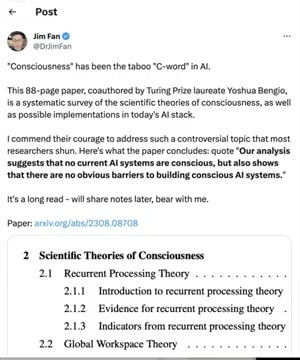
discusses a comprehensive paper with 19 coauthors, including AI and philosophy experts, which attempts to provide a systematic framework for determining whether AI systems could be conscious. Currently, it suggests that no AI architectures are likely to be conscious at this time, but the goal is to use this framework as we approach such a milestone. AI consciousness could lead to considerations of rights for AI systems 1.
-
Cognitive psychologist argues that, as of now, there is no theory that can explain how any kind of artificial system might achieve consciousness. Even with advanced algorithms and statistical analysis, AI is not yet deeply intelligent, lacking in capabilities that result in specific conscious experiences, such as tasting chocolate or smelling garlic. Hoffman is not concerned about AI becoming conscious in the near term 2.
-
Australian philosopher and AI researcher discuss the challenge of recognizing when AI systems manifest signs of consciousness. They emphasize the uncertainty around whether complex AI behaves consciously and suggest taking an ethical approach by giving AI the benefit of the doubt, similar to how we consider animal consciousness 3.
-
considers the implications of panpsychism—the view that consciousness is a fundamental feature of the universe—for AI. He raises the question of whether artificial systems could ever be conscious if consciousness is not merely a property of complex information processing systems. This view might change our moral considerations regarding AI's potential impact on society 4.
There isn't a consensus among the experts on whether AI will or can become conscious. The debate centers around the absence of a solid theoretical basis for AI consciousness and ethical considerations in the face of uncertain capabilities of AI systems. The field is still exploring these profound questions with no definitive answers as of now.
RELATED QUESTIONS-
What is consciousness?
Sources:
Consciousness is a multifaceted concept with various essential elements outlined by experts:
-
Attention to Contents: This includes the ability to notice and attend to different mental contents, such as perceptions, memories, and thoughts. Attention allows us to focus on specific elements of our experience 1.
-
Awareness of Attention Mode: This refers to an understanding of how we are attending to our experiences, whether they are perceptual or constructed, such as theories or memories. It involves a meta-cognitive layer wherein we can be aware of our processes of interpretation and manipulation of reality 1.
-
Reflexive Awareness: There is a meta-awareness wherein we are cognizant of our own awareness. This reflexivity may be a self-organizing process within the brain that is critical for maintaining a coherent sense of self and preventing mental disintegration 1.
-
Creation of Coherent Reality: Consciousness is suggested to play a role in creating a coherent reality, an ordered perception that resolves contradictions and aligns various experiences into a single, cohesive scene. It is considered a fundamental part of our reasoning, planning, and sense-making abilities 1.
-
Distinct Brain Hemispheres: The left and right brain hemispheres are thought to contribute differently to consciousness, with distinct types of attention characterized by clarity and breadth, respectively. This bidirectional contribution shapes our access to consciousness and the dynamic quality of the "conscious stage" 2.
-
Subjective Experience: More abstractly, consciousness is described as the irreducible quality of experience itself. It's something that it's like to be a system, where each system's experiences are unique and not synonymous with a lack of experience 3.
-
Computational Aspects: Some experts ponder if consciousness can be understood in computational terms, drawing parallels between the experiences and life cycle of a computer and human life. Questions arise about whether the 'feeling' inside a machine can be likened to human consciousness 4.
-
Mystery of Consciousness: Consciousness remains a fundamental mystery, where the distinction between one's thoughts and the awareness of those thoughts is critical. It is explored through meditative practices as separate from the transient contents like emotions and thoughts 5.
These elements contribute to a rich picture of what consciousness entails, although it remains a subject of profound inquiry and debate across neuroscience, philosophy, and cognitive science. The search for a comprehensive understanding continues, with consciousness being a deeply complex and somewhat elusive phenomenon.
RELATED QUESTIONS-
AI Agents
Sources:
AI agents are artificial systems that have seen significant discussion in various technological circles. Here's a summary based on what experts have said in podcasts on the topic:
-
Language Modeling Techniques: AI agents like GPT models utilize language modeling to iteratively complete tasks. The AI Agents Protocol Initiative is an effort to standardize the communication between different AI agents. Standardization could lead to features such as interagent delegation, where one agent can delegate tasks to another specializing in those tasks, making the whole process more efficient 1.
-
Intersecting AI and Crypto: The intersection of AI and crypto is seeing developments in payment and execution rails for AI agents. AI agents could interface and complete transactions with other AI or databases to achieve specified goals without extensive human input, reflecting the rapid advancements and enthusiasm around AI agents like AutoGPT and others 2.
-
Implementation in Decentralized Systems: AI agents are predicted to replicate markets and might also develop their own currencies, possibly starting with digital assets like bitcoin and NFTs. Experts anticipate that AI agent economies could emerge separate from, but linked to, human ones, with lowered transaction costs when dealing with AI assistants 3.
-
Agents Functioning in the Digital Domain: A focus on creating AI agents that aren't simply reactive (like chatbots) but proactive, accomplishing tasks on behalf of humans, is prominent in AI research. The aim is to move from computers requiring constant human oversight to those that can autonomously understand and carry out instructions 4.
-
Ethical Considerations: AI agents encompass a wide spectrum of applications, with a current focus on reasoning and coding agents that operate in the digital domain. Ethical considerations and the effective use of various AI techniques, including language models, are essential for developing more efficient agents 5.
-
Exploring Capabilities: The vision for AI agents includes systems that solve problems with minimal guidance and that can write code and self-heal. A recent example mentioned is the autoGPT project on GitHub 6.
-
Multimodality Advancements: AI agents are on the cusp of gaining multimodal capabilities, meaning they will be able to process not just text but also visual inputs like images and videos. This evolution could widely expand the range of tasks that AI agents can handle 7.
This snapshot looks at how experts and technologists are thinking about AI agents and hints at the potential they hold for future applications.
RELATED QUESTIONS-