
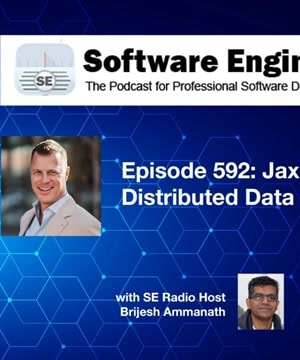
SE Radio 592: Jaxon Repp on Distributed Data Infrastructure
Topics covered
Popular Clips




Episode Highlights
Migration Complexities
discusses the complexities of migrating to distributed data infrastructure, emphasizing the need to maintain system functionality during the transition. He highlights the importance of understanding the existing topology and planning for future scalability without disrupting current operations 1. Jaxon notes, "Infrastructure and migration feels like a multi-year task," underscoring the challenge of extending existing systems without a complete overhaul 1. Additionally, he explains the necessity of educating both decision-makers and IT teams about the intricacies of distributed systems, as they often involve significantly more components than traditional setups 2.
Optimization Strategies
Optimization in distributed data infrastructure is crucial for performance and efficiency. Jaxon describes the concept of eventual consistency, where data synchronization across nodes may not be instantaneous but is optimized for speed and availability 3. He explains, "Eventual consistency means that I will write it, but it might not be immediately available," highlighting the trade-offs between consistency and performance 3. Tools and strategies are employed to ensure low latency and effective data management, especially in IoT applications where data is generated from numerous devices globally 4.
Latency Reduction
Reducing latency in distributed setups involves strategic placement and integration of application layers. Jaxon explains how HarperDB's approach to building a full-function application layer on top of their database helps lower latency by minimizing the distance between data and client connections 5. He states, "We built a full function application layer on top of the database, specifically because we wanted to lower latency," emphasizing the importance of proximity in data management 5. Additionally, storing data locally in environments with poor connectivity ensures continuous operation and data collection, which can later be synchronized with central systems 6.
Related Episodes


SE Radio 561: Dan DeMers on Dataware
Answers 383 questions

SE-Radio Episode 285: James Cowling on Dropbox’s Distributed Storage System
Answers 383 questions
SE Radio 560: Sugu Sougoumarane on Distributed SQL Databases
Answers 383 questions

SE Radio 594: Sean Moriarity on Deep Learning with Elixir and Axon
Answers 383 questions

SE Radio 605: Yingjun Wu on Streaming Databases
Answers 383 questions

SE-Radio Episode 344: Pat Helland on Web Scale
Answers 383 questions

SE Radio 571: Jeroen Mulder on Multi-Cloud Governance
Answers 383 questions

SE-Radio-Episode-235:-Ben-Hindman-on-Apache-Mesos
Answers 383 questions

SE-Radio Episode 264: James Phillips on Service Discovery
Answers 383 questions

SE-Radio Episode 288: DevSecOps
Answers 383 questions

SE Radio 585: Adam Frank on Continuous Delivery vs Continuous Deployment
Answers 383 questionsSE-Radio-Episode-259:-John-Purrier-on-OpenStack
Answers 383 questions

Episode 544: Ganesh Datta on DevOps vs Site Reliability Engineering
Answers 383 questions

SE-Radio Episode 243: RethinkDB with Slava Akhmechet
Answers 383 questions

SE-Radio Episode 276: Björn Rabenstein on Site Reliability Engineering
Answers 383 questions