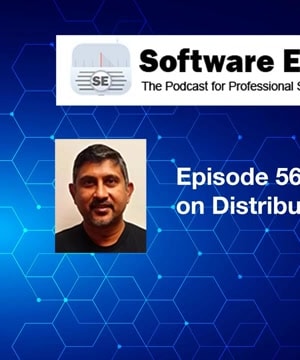
SE Radio 560: Sugu Sougoumarane on Distributed SQL Databases
Topics covered
Popular Clips




Episode Highlights
Pooling Significance
Connection pooling was a pivotal development in Vitess, addressing the challenges of managing numerous database connections. explains that the initial pain point was the overwhelming number of connections to MySQL, especially during failovers, which could bring down the new primary database 1. To solve this, a middle layer was introduced to pool connections, which evolved into a full-fledged distributed database system. This architectural decision, including the creation of a parser, allowed Vitess to handle complex queries and enhance MySQL's performance 2.
The beauty is, once you figure out that there is a middle layer that can get requests and send them to the database, people then start looking for features in it.
---
This decision laid the foundation for Vitess's evolution and its ability to manage database traffic efficiently.
Spike Management
Handling spikes in database connections is another critical function of Vitess's connection pooling. Sugu notes that without this layer, a sudden influx of connections could overwhelm MySQL, leading to performance degradation 2. By limiting the number of connections to what MySQL can handle, Vitess prevents a domino effect where everything backs up and nothing completes. This ensures that even during high traffic, the database remains protected and operational.
If there is a huge overload, all other queries are waiting to, and MySQL does not get pushed over its limit.
---
Thus, Vitess maintains optimal performance by managing connection spikes effectively.
Architectural Insights
The architectural decisions behind Vitess were crucial in its development as a distributed database system. Sugu highlights the decision to write a parser as a significant milestone, which allowed Vitess to understand and mediate incoming queries 1. This capability was essential for expanding beyond simple connection pooling to more complex database management tasks. The parser's development was informed by Sugu's past experience, which proved invaluable in Vitess's evolution.
The most difficult decision that we had to make was whether to write a parser.
---
These decisions have paid off, enabling Vitess to efficiently manage database operations.
Related Episodes


SE-Radio Episode 243: RethinkDB with Slava Akhmechet
Answers 383 questions

SE Radio 605: Yingjun Wu on Streaming Databases
Answers 383 questions

Episode 510: Deepthi Sigireddi on How Vitess Scales MySQL
Answers 383 questions
SE-Radio Episode 362: Simon Riggs on Advanced Features of PostgreSQL
Answers 383 questions
SE-Radio Episode 354: Avi Kivity on ScyllaDB.mp3
Answers 383 questions

SE-Radio Episode 353: Max Neunhoffer on Multi-model databases and ArangoDB
Answers 383 questions

SE Radio 561: Dan DeMers on Dataware
Answers 383 questions

SE Radio 623: Mike Freedman on TimescaleDB
Answers 383 questions

SE-Radio Episode 344: Pat Helland on Web Scale
Answers 383 questions

SE-Radio Episode 288: DevSecOps
Answers 383 questions

SE Radio 631: Abhay Paroha on Cloud Migration for Oil and Gas Operations
Answers 383 questions
364: Peter Zaitsev on Choosing the Right Open Source Database
Answers 383 questions

SE Radio 583: Lukas Fittl on Postgres Performance
Answers 383 questions