
StarTalk Live Podcast: Big Brains at BAM with Neil deGrasse Tyson

Topics covered
Popular Clips
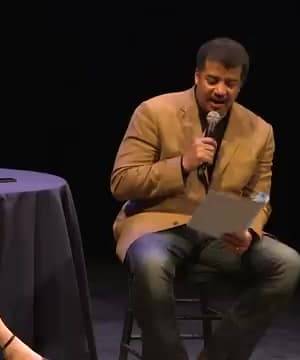


Questions from this episode
- Asked by 397 people
- Asked by 130 people
- Asked by 112 people
- Asked by 105 people
- Asked by 98 people
- Asked by 77 people
- Asked by 74 people
- Asked by 60 people
- Asked by 54 people
- Asked by 45 people
- Asked by 44 people
- Asked by 42 people
- Asked by 36 people
- Asked by 34 people
- Asked by 29 people
Episode Highlights
Mars Challenges
The challenges of colonizing Mars are multifaceted, involving both environmental and logistical considerations. highlights the need for sustainable food sources, suggesting that vegan recipes could be crucial for the first colonists due to the inefficiency of transporting livestock 1. adds that veganism aligns with environmental concerns, as it minimizes resource consumption 1. The conversation also touches on the concept of terraforming Mars, which would involve creating an atmosphere capable of supporting human life 2. notes the potential for creating an "air shield" to trap air and facilitate agriculture on the planet 2.
A cow is a machine to turn leaves into steak. Right. In the theory, maybe that's what that is.
---
The panel humorously debates the practicality of bringing cows to Mars, ultimately agreeing on the importance of efficient resource use 2.
Space Adaptation
Space environments pose unique challenges to human physiology, particularly in terms of brain adaptation. explains that the brain exhibits plasticity, adapting to the altered conditions of space, such as zero gravity and disrupted circadian rhythms 3. This adaptability raises concerns about the long-term effects on developing brains, suggesting that children should not be exposed to space environments 3. emphasizes the potential risks of missing critical developmental stimuli in space, which could lead to permanent changes 3.
If a kid were born in space, that he or she came back to Earth? Couldn't figure it out. You don't know.
---
The discussion also explores the hypothetical scenario of a child born in space, questioning how their brain development would differ from Earth-born individuals 4.
Related Episodes


StarTalk Live! Big Brains at BAM (Part 1)
Answers 383 questionsStarTalk Live! Big Brains at BAM (Part 3)
Answers 383 questionsStarTalk Podcast: Science of the Brain with Neil deGrasse Tyson
Answers 383 questions
StarTalk Live! Big Brains at BAM (Part 2)
Answers 383 questions
StarTalk Live - Neil deGrasse Tyson and The Future of Science
Answers 383 questions
StarTalk Podcast: Our Galaxy And Beyond, with Neil deGrasse Tyson
Answers 383 questions
Neil deGrasse Tyson – StarTalk Live at New York Comic Con 2019
Answers 383 questions
StarTalk Podcast: Everyday Astrophysics with Neil deGrasse Tyson and Russell Peters
Answers 383 questions
StarTalk Live: Climate Science, with Neil deGrasse Tyson & Special Guests
Answers 383 questionsStarTalk Podcast: Cosmic Queries – The Deep with Neil deGrasse Tyson
Answers 383 questions
StarTalk Live with Neil deGrasse Tyson: Searching for Life in the Universe
Answers 383 questionsStarTalk Podcast: Cosmic Queries – The Random Edition, with Neil deGrasse Tyson
Answers 383 questionsStarTalk Podcast: Physics All Around Us, with Neil deGrasse Tyson
Answers 383 questionsNeil deGrasse Tyson: StarTalk Live at Kings Theatre – Science and Morality
Answers 383 questions
StarTalk Podcast: Technology and Us, with Ainissa Ramirez and Neil deGrasse Tyson
Answers 383 questions