
708: ChatGPT Code Interpreter: 5 Hacks for Data Scientists — with Jon Krohn (@JonKrohnLearns)
Topics covered
Popular Clips


Episode Highlights
Data Analysis
In the realm of exploratory data analysis, highlights the efficiency of ChatGPT's Code Interpreter. It seamlessly handles tasks like checking for missing values, summarizing key variables, and visualizing data distributions. Jon explains how the tool identifies errors, such as mismatched column names, and automatically corrects them without user intervention 1.
It appears there was an error in accessing the specified columns from the data set. This might suggest that the provided data set does not have the traditional columns or they might be named differently.
---
The interpreter also generates histograms and scatter plots, providing concise summaries of the data's main characteristics 2.
Preprocessing
Automated preprocessing is another powerful feature of the ChatGPT Code Interpreter. describes how it efficiently handles feature scaling, selection, and data splitting for machine learning tasks. The tool identifies irrelevant preprocessing steps and skips them, ensuring a streamlined workflow 3.
We'll do feature scaling, we'll handle categorical data, we'll do feature selection, and then we'll split the data into a training and test set.
---
This automation simplifies the preparation of data for linear regression models, making it accessible even for those who may not be familiar with specific variable names 2.
Machine Learning
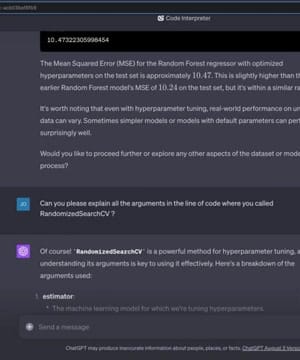
Integrating machine learning models with the Code Interpreter is both intuitive and efficient. demonstrates how the tool trains and evaluates models, such as linear regression, using the scikit-learn library. It provides summary statistics like mean squared error and r-squared scores, offering insights into model performance 4.
Improving the performance of a regression model in terms of reducing the mean squared error can be approached in multiple ways.
---
The interpreter suggests advanced modeling techniques, including random forests and gradient boosted trees, and offers strategies for feature engineering and hyperparameter tuning 5.
Related Episodes

660: Five Ways to Use ChatGPT for Data Science — with Jon Krohn (@JonKrohnLearns)
Answers 383 questions666: GPT-4 — with Jon Krohn (@JonKrohnLearns)
Answers 383 questions670: LLaMA: GPT-3 performance, 10x smaller — with Jon Krohn (@JonKrohnLearns)
Answers 383 questions638: ChatGPT Holiday Greeting — with @JonKrohnLearns
Answers 383 questions
649: Introduction to Machine Learning — with Kirill Eremenko and Hadelin de Ponteves
Answers 383 questions
826: In Case You Missed It in September 2024 — with Jon Krohn (@JonKrohnLearns)
Answers 383 questions768: Is Claude 3 Better than GPT-4? — with Jon Krohn (@JonKrohnLearns)
Answers 383 questions
733: OpenAssistant: The Open-Source ChatGPT Alternative — with Dr. @YannicKilcher
Answers 383 questions

808: In Case You Missed It in July 2024 — with Jon Krohn (@JonKrohnLearns)
Answers 383 questions