
Exploring TensorFlow 2.0 with Paige Bailey - TWiML Talk #242
Topics covered
Popular Clips



Episode Highlights
Eager Execution
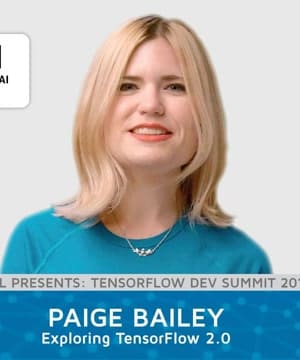
The introduction of eager execution in TensorFlow 2.0 marks a significant shift in the development experience, making it more intuitive and Pythonic. explains that eager execution allows developers to interact with TensorFlow without creating static graphs or sessions, simplifying the coding process 1. This change is part of a broader effort to enhance developer productivity and ease of use, with noting the reduction in code complexity 2.
Community Focus
Community involvement is a cornerstone of TensorFlow 2.0's development, with the RFC process allowing anyone to propose changes to the API. highlights the shift from a top-down approach to a more collaborative model, engaging users from diverse backgrounds 3. This inclusive process ensures that changes are well-informed and widely accepted, fostering a sense of ownership among the community 4.
TF Function
TF Function and Autograph are pivotal in simplifying TensorFlow programming by transforming Python code into efficient TensorFlow operations. describes TF Function as a tool that wraps Python functions into core TensorFlow operations, enhancing flexibility and performance 5. Autograph further streamlines this process by automatically converting Python code into TensorFlow graph code, supporting a wide range of Python features.
Innovations
TensorFlow 2.0 introduces several innovations aimed at improving model performance and scalability. notes that while the code for creating neural networks remains concise, significant optimizations occur under the hood, particularly for distributed architectures 5. These enhancements make TensorFlow 2.0 a powerful tool for developers seeking to leverage machine learning at scale.
Related Episodes


Supporting TensorFlow at Airbnb with Alfredo Luque - TWiML Talk #244
Answers 383 questions
The Fastai v1 Deep Learning Framework with Jeremy Howard - TWiML Talk #186
Answers 383 questions
Applied Machine Learning for Publishers with Naveed Ahmad - TWiML Talk #182
Answers 383 questions
Managing Deep Learning Experiments with Lukas Biewald - TWIML Talk 295
Answers 383 questions
TWIML Open Briefing with Warren Barkley
Answers 383 questions
Productizing ML at Scale at Twitter with Yi Zhaung - TWIML Talk #271
Answers 383 questionsTrends in Deep Learning with Jeremy Howard - TWiML Talk #214
Answers 383 questions
Productive Machine Learning at LinkedIn with Bee-Chung Chen - TWiML Talk #200
Answers 383 questions
Scaling TensorFlow at LinkedIn with Jonathan Hung - #314
Answers 383 questions
Exploring the FastAI Tooling Ecosystem with Hamel Husain - #532
Answers 383 questions
Federated ML for Edge Applications with Justin Norman - TWiML Talk #185
Answers 383 questions
Natural Language Processing at StockTwits with Garrett Hoffman - TWiML Talk #194
Answers 383 questions


