
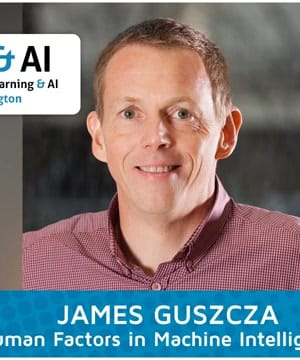
Human Factors in Machine Intelligence with James Guszcza - #56

Topics covered
Popular Clips




Episode Highlights
Blending Techniques
James Guszcza, US Chief Data Scientist at Deloitte Consulting, emphasizes the importance of blending human judgment with machine algorithms. He explains that while algorithms can automate tasks like credit scoring, they lack the common sense and ethical understanding that humans possess 1. This combination is crucial in complex decision-making scenarios, such as underwriting loans or medical diagnoses, where human insight complements machine precision 2. Guszcza uses the metaphor of freestyle chess to illustrate this collaboration, highlighting how humans can override algorithms when necessary, using their intuition and contextual knowledge 3.
The computer can do things that humans aren't good at, like look through this decision tree of all these possible moves and all the implications, these moves downstream better than a human can.
---
This approach ensures that AI systems are not only efficient but also aligned with societal values and organizational goals.
Decision-Making
Guszcza discusses how AI can enhance decision-making processes by addressing the limitations of unaided human judgment. He notes that algorithms, like those used in credit scoring, often outperform human decision-makers by providing consistent and data-driven insights 4. However, he acknowledges that decision-making is not always a science and often involves satisficing, where decisions are made based on practical constraints rather than optimal solutions 5. This is particularly relevant in scenarios where resources are limited, and AI can provide valuable support by offering preliminary assessments.
Unaided judgment is notoriously unreliable when it comes to making judgments and decisions.
---
By integrating AI into decision-making, organizations can leverage its strengths while still relying on human oversight for nuanced and context-sensitive decisions.
AI Integration
The integration of AI functionalities into organizational systems is a key focus for Guszcza, who advocates for augmenting human intelligence rather than replacing it. He describes how AI can assist in tasks like insurance underwriting by providing data-driven insights while allowing humans to apply their judgment and expertise 6. This approach, known as augmentation, enhances human capabilities and ensures that AI tools are used effectively within the organizational context 7.
Augmentation or some other.
---
By focusing on augmentation, organizations can improve efficiency and decision-making without losing the human element that is crucial for understanding complex and dynamic environments.
Related Episodes


The Future of Human-Machine Interaction with Dan Bohus and Siddhartha Sen - #499
Answers 383 questions
Philosophy of Intelligence with Matthew Crosby - #91
Answers 383 questions
The Limitations of Human-in-the-Loop AI with Dennis Mortensen - #67
Answers 383 questions
Towards Artificial General Intelligence with Greg Brockman - #74
Answers 383 questions
A Social Scientist’s Perspective on AI with Eric Rice - #511
Answers 383 questions
AI Engineering Pitfalls with Chip Huyen - 715
Answers 383 questions
Human-in-the-Loop AI for Emergency Response & More with Rob Munro - #125
Answers 383 questions
Studying Machine Intelligence with Been Kim - #571
Answers 383 questions
AI Storytelling Systems with Mark Riedl - #478
Answers 383 questions
Accelerating Intelligence with AI-Generating Algorithms with Jeff Clune - 602
Answers 383 questions
Pushing Back on AI Hype with Alex Hanna - 649
Answers 383 questions
AI and Society: Past, Present and Future with Eric Horvitz - #493
Answers 383 questions
Engineering a Less Artificial Intelligence with Andreas Tolias - #379
Answers 383 questions
Explaining the Predictions of Machine Learning Models with Carlos Guestrin - #7
Answers 383 questions
