
AI-Powered Conversational Interfaces with Paul Tepper - #52

Topics covered
Popular Clips






Episode Highlights
Voice Design
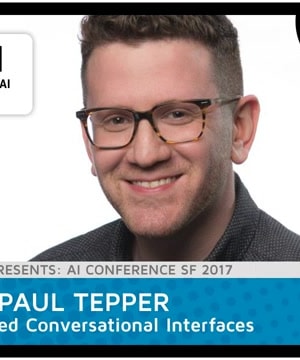
from Nuance Communications discusses the intricacies of voice interface design, emphasizing the importance of blending conversational and web user interface principles. He highlights the role of voice biometrics in enhancing security, allowing users to authenticate with voice prints, which is particularly useful in mobile devices 1. Paul notes the challenges of integrating voice biometrics with platforms like Google Home and Alexa, as these systems currently only transmit text, not audio signals 2. This limitation underscores the need for cognitive arbitration, where agents coordinate across various IoT systems to improve user experience 3.
It's interesting. Now, nuance has been doing, we call VUI design for a long time, or voice user interface design.
---
The integration of these technologies is crucial for advancing AI-powered conversational interfaces.
Intent Recognition
Intent recognition is a pivotal aspect of AI systems, focusing on understanding user intentions within dialogues. Paul explains the shift towards unsupervised learning techniques to automatically identify user intents from chat logs, significantly reducing the time required for intent discovery 4. He acknowledges the complexity of dialogues with multiple or hidden intents, which remain a challenge for current systems 5. Despite advancements, Paul notes that many platforms still rely on manual processes for building entity trees, highlighting the need for more sophisticated AI solutions 6.
We're working on looking at datasets and extracting those intents automatically through unsupervised learning.
---
These innovations aim to streamline the development of conversational interfaces.
Human Loop
The concept of "human in the loop" is crucial in refining AI systems, ensuring accuracy and reliability. Paul describes a process where human agents assist AI by verifying intents that the system cannot confidently identify, creating a seamless user experience 7. This approach not only improves system accuracy but also offers new business models for companies like Nuance, which can provide both technology and human support 8. By integrating human expertise, AI systems can learn and adapt more effectively, bridging the gap between automated and manual processes.
The system won't necessarily have the same accuracy as it would with a hand tuned system.
---
This collaboration enhances the overall functionality of conversational interfaces.
Related Episodes


Hyper-Personalizing the Customer Experience with AI, w/ Rob Walker - #127
Answers 383 questions
Building Conversational Interfaces for Financial Services with Kenneth Conroy - #61
Answers 383 questionsAI for Enterprise Decisioning at Scale with Rob Walker - #573
Answers 383 questions
AI-Powered Peer Programming with Vasi Philomin - #594
Answers 383 questions
AI Innovation for Clinical Decision Support with Joe Connor - TWiML Talk #169
Answers 383 questions
Building AI Voice Agents with Scott Stephenson - 707
Answers 383 questions
AI for Healthcare with Peter Lee - TWiML Talk #231
Answers 383 questions
Omni-Channel Customer Experiences with Vince Jeffs - #154
Answers 383 questions
Emotional AI: Teaching Computers Empathy with Pascale Fung - #9
Answers 383 questions
Engineering the Future of AI with Ruchir Puri - #21
Answers 383 questions
Global AI Trends with Ben Lorica - #26
Answers 383 questionsEmpathy in AI with Rob Walker - TWiML Talk #248
Answers 383 questions
AI Storytelling Systems with Mark Riedl - #478
Answers 383 questions
Automating Complex Internal Processes with AI, w/ Alexander Chukovski - #161
Answers 383 questions
Automated Machine Learning with Erez Barak - #323
Answers 383 questions